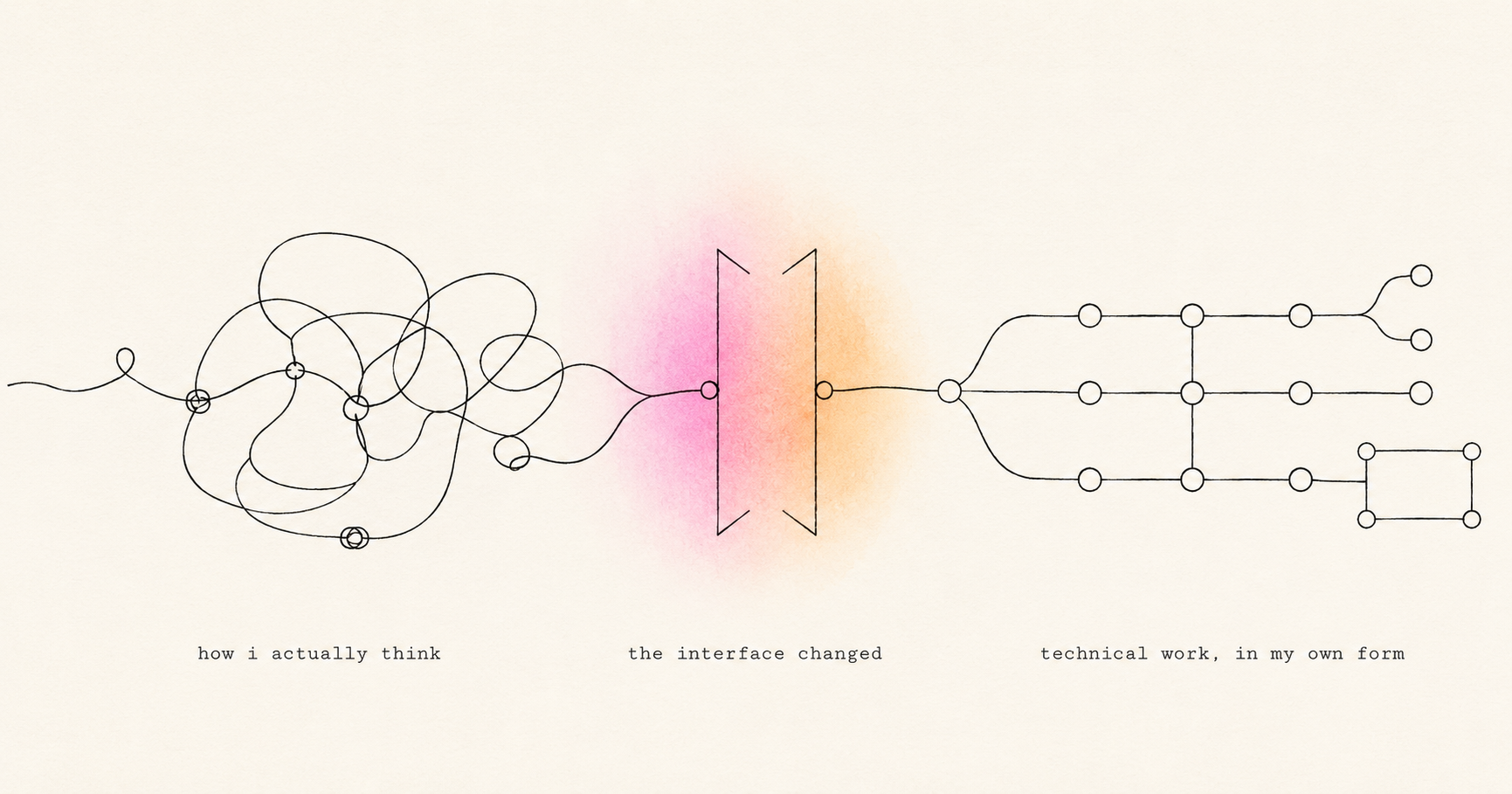
I started a design agency before I was really a designer. That still sounds backwards to me, but it explains a lot about how I work.
At the beginning, people hired us because they wanted the visible thing: a logo, a website, a pitch deck, or a cleaner way to explain the company.
But the real work was usually underneath that. A founder was too close to the business to see it clearly. The intent, ambition, and market intuition were all there, but they were tangled up in proximity, pressure, unfinished language, and a thousand details that all felt important.
Design was often the artifact people knew how to ask for. Translation was the work they actually needed.
That pattern has followed me for most of my career. I am useful when I can sit inside a messy situation and find the structure: the story, the system, the sequence, the language, and the proof. I tend to notice relationships between things that other people are holding in separate rooms.
For a long time, technical work felt like the one place that instinct could not reach.
I had ideas for systems, tools, interfaces, operating loops. I could see how they should behave. I could feel when a workflow was wrong. But I could not speak the machine’s language directly. I needed a technical human to translate, and good translators are rare. Most software work asked me to enter through the door I was worst at: syntax, setup, docs, invisible assumptions, and a lot of staring at things before I knew enough to ask the right question.
The chat box changed the interface.
Suddenly I could approach technical work the way I approach other work: by talking through intention, reasoning about options, pushing on tradeoffs, testing the shape, and asking where the thing breaks. I could describe what I wanted in terms of behavior and judgment, and the machine could help translate that into the technical layer.
That did not remove the need for judgment. It made judgment more directly executable.
That is the part I think gets flattened in the usual AI conversation. The interesting thing is not only that AI can write code. It is that AI can change the interface to technical work. It can let more kinds of minds participate in the building process without first forcing them to become someone else.
Since February, I have gone from basically zero technical fluency to directing thousands of commits across a public writing system, a personal operating system, home-operation workflows, GTM infrastructure, product prototypes, research systems, and a control layer for coordinating agent work.
The volume is not the point. It would be easy to turn that into a vanity stat.
The point is the shape of the work. A conversation becomes context, context becomes a packet, and a packet becomes a buildable slice. A builder returns proof, a reviewer checks the work, and human judgment decides whether it counts.
That loop matters because AI can very easily become an affirmation machine, a house of mirrors with better typography. If all it does is reflect your own certainty back at you, it will make your bullshit faster.
The useful version has friction: options, reasoning, tradeoffs, tests, receipts, review, boundaries, and a clear difference between output, review, and acceptance.
That is why the work I am most interested in is not “vibe coding.” It is not the claim that everyone should work with AI the way I do. It is the opposite: AI creates the possibility of building a technical interface around the way a person actually thinks, but that interface only becomes serious when it keeps returning to reality.
For me, that means I can stay closer to the work I am best at: translating ambiguity into structure, making fast judgment calls, seeing the through line, and deciding what needs to be held tightly versus what can stay loose.
It also means more of the work that used to drain me can move through a system: research passes, drafts, prototypes, GTM infrastructure, rebrand explorations, product-roadmap shape, and the mechanical parts of keeping context alive.
Not so I can spend every freed-up hour doing more work.
So the work takes less of the parts of me my family needs.
I still cannot sit down and write a whole application from memory. I am not pretending to be a traditional engineer. But I can now direct systems into existence. I can reason about the architecture. I can test the experience. I can notice when the abstraction is wrong. I can make the calls.
That does not feel like a shortcut around technical work.
It feels like technical work finally showing up in a form my judgment can touch.