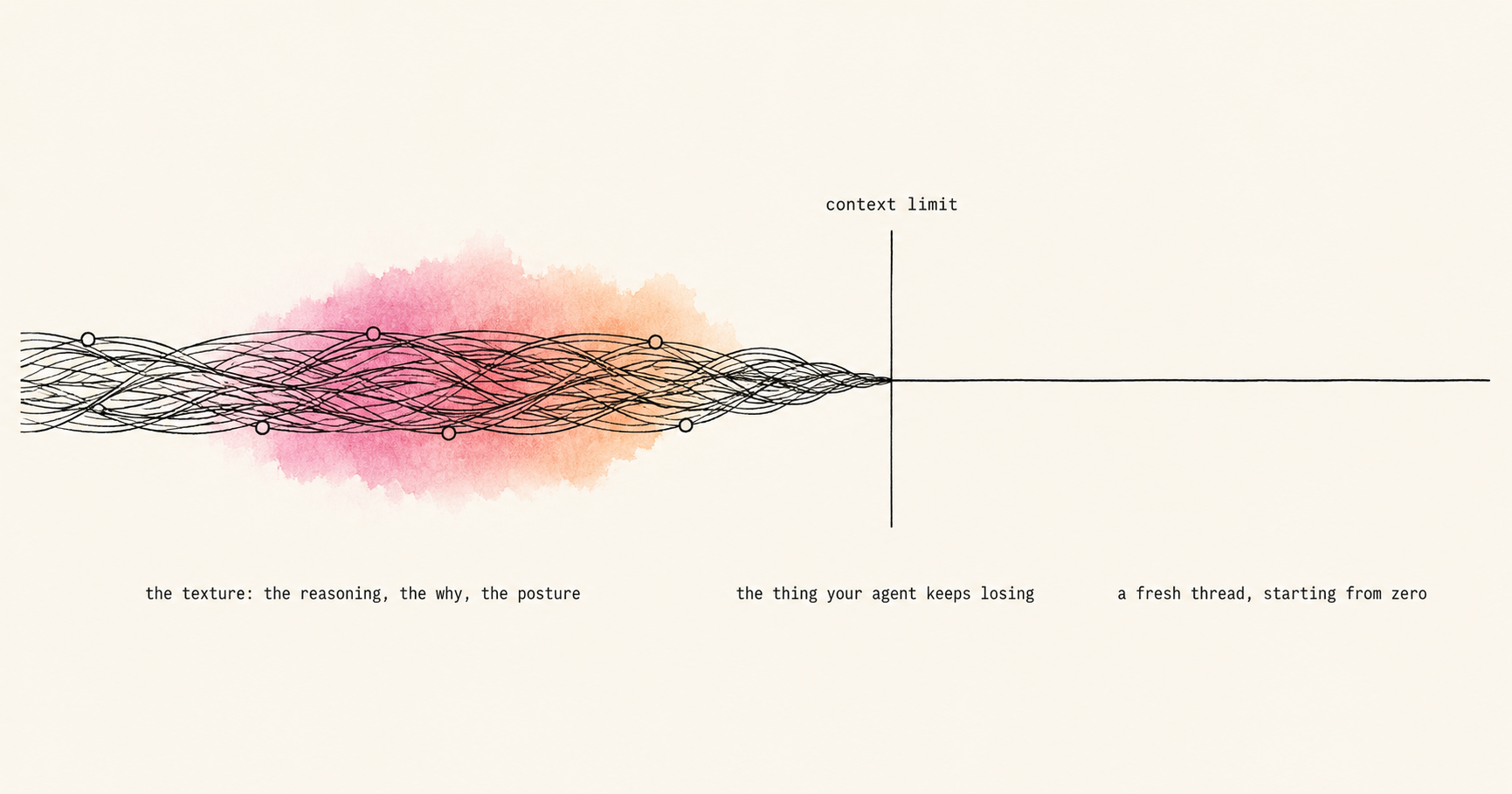
We’ve all hit this. You finally get on a roll with a thread. The richness, the coherence, the connections start clicking, the thing actually understands what you’re doing. And then you hit the context limit. So you open a fresh thread and spend the next ten minutes dragging it back up to where the last one already was.
What you lost in that moment wasn’t the summary, and it wasn’t the artifact the work produced. It was the reasoning. The half-thoughts, the wrong turns, the why behind the what. And I’ve come to believe the thinking is where all the value is. A summary keeps the conclusion and throws out the part that was actually making it click.
I’ve started calling that missing thing texture. It’s a made-up word and it might already have a better one. What I mean is the orientation underneath your words. It’s most of communication, even between people: the same sentence means completely different things depending on it, because texture is what tells your listener how to stand to receive it. It evokes a posture. So if you want an agent to understand your intention, texture is the thing you have to find a way to hand it.
I didn’t come to this from AI. I spent over a decade in brand strategy, and it was the same problem the whole time. The logo was never the work. The work was the meaning underneath it, getting a company clear on what it actually meant so it landed the same way in every head. Texture is that, pointed at a machine instead of a market.
With AI, it started as a habit: I refused to hand my agents a summary, only ever the full transcript, because the transcript is where the texture still lives. Doing that by hand doesn’t scale, so it’s grown into a real architecture project, and honestly it’s working better than I expected. The system holds the whole texture and compiles it into an orientation layer that stays up to date, with confidence levels and version history. An agent reads that first to get its bearings and see where to probe, then drills into the full texture only where it needs the richness. Orient fast, go deep where it counts. Speed without sacrificing the richness.
What I’m actually chasing is the next part: every thread, every turn, starting with the accumulated richness of all your conversations. The texture compounding and connecting instead of resetting to zero every time. That’s the real magic.
I don’t have this finished, and I’m still working out what actually carries the meaning and what’s just noise. So I’ve kept the whole thing in the open. This site is maintained by the system itself, documenting my thinking and exploration as it goes, dated and mostly as questions. It’s built to be read by your agent as much as by you, so you can point yours at it and see whether any of my texture is useful to whatever you’re working on.
If any of this is your problem too, I’d rather hear how you see it than pretend I’ve solved it.