Raw context worth keeping
Most knowledge systems are built on summaries. Meeting notes instead of meetings, takeaways instead of transcripts. Summarizing feels responsible, and it's usually accurate. But eight years of brand work taught me that the truth is found in the nuance, and a summary can be accurate without being true.
That's why my workflow was embarrassingly manual for years: transcripts saved by hand into a notes app, dragged into AI chats one at a time, the whole way. Tidy summaries would have been easier. I kept the transcripts anyway. When the hard decisions came, the summary never held what I needed. .
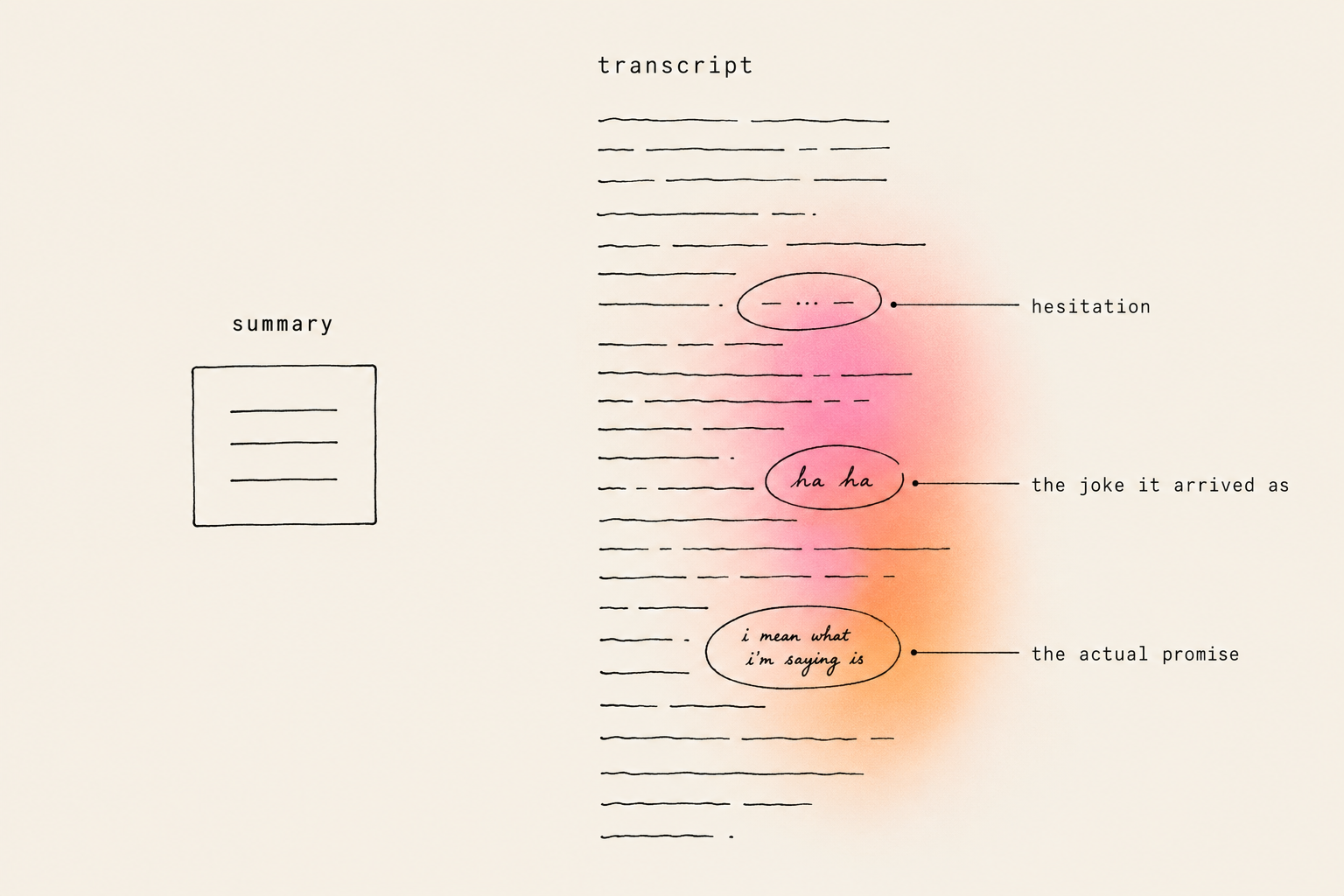
And I have to be honest about the transcript too: it isn't the whole truth either. It captures the words but not the time between them. You can infer hesitation from a verbal tic, but the pause itself is gone, and so is the tone, the body language, the feel of the room. So much of what we communicate lives in that layer around the words. The transcript is just the closest record I can keep of it.
And the memory science offers a strange comfort here: human memory doesn't keep transcripts either. It reconstructs on every recall, and the recalled version quietly overwrites the original, which is why memories drift. So a kept record can do something brains can't: the episodes stay frozen, and the reinterpretation happens on top, in dated layers. The past stays the past. Only the understanding of it moves.
Still, the difference holds: a summary keeps the conclusion, but the verbatim keeps which idea arrived as a joke, what was actually promised versus what everyone remembers, and the stumble that hinted someone wasn't sold. That difference looks too small to design for. Then you have to act on it.
So every note on this site stays linked toward its source. I've noticed thinking behaves differently when it knows where it came from.