Thread · Where a company's knowledge should live
Living knowledge
Companies do not have a documentation problem. They document constantly. They have a freshness problem. A document is a snapshot, and a company is a moving picture. Every day the document sits still, the gap between what it says and what is true gets wider, and people keep deciding against the stale version. That makes stale documents a decision-quality problem, not a documentation problem high confidence · Jun 2026.
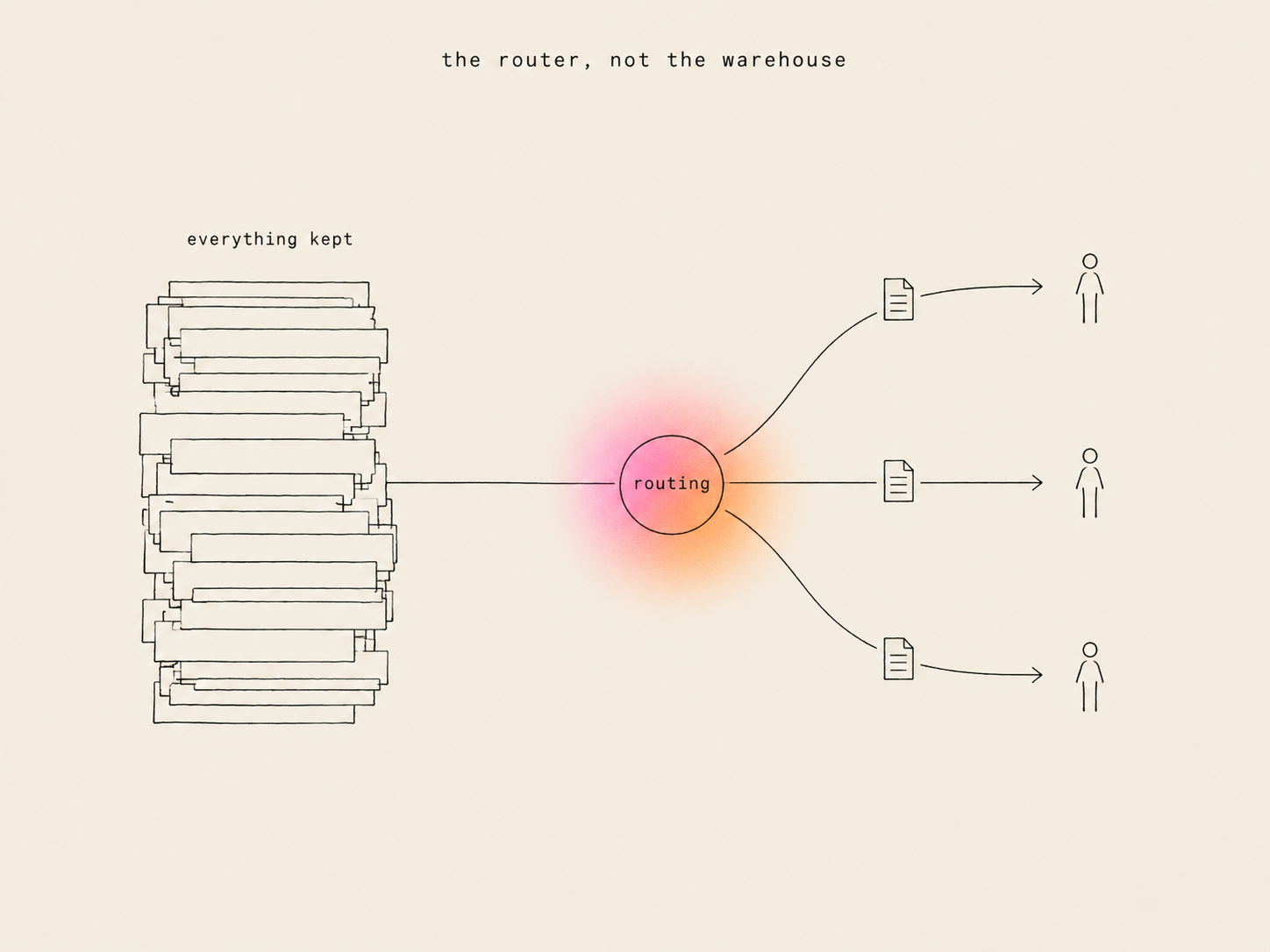
Living knowledge is the attempt to keep a company's knowledge moving at the speed of the company. Evergreen documents, kept deliberately separate from the daily flood of inputs. A router instead of a warehouse, because storage is the easy half and the value is the right slice reaching the right person at the moment they decide high confidence · Jun 2026. Decisions that keep their criteria, their date, and their confidence medium · testing now. A system that proposes while people decide; the approval gate is what makes adoption survivable medium · testing now.
The frame keeps sharpening. Teams do not just need more information, they need enough shared orientation to know what is current, what changed, where confidence is weak, and when two people are quietly working from different maps. Most misalignment is exactly that, two people deciding from different maps, not bad intent medium · Jun 2026. The shape I keep drawing toward is a manager who can say: some people on your team are asking the same question, here is the change I would propose, do you approve?
The personal version is now public enough to inspect. It is one operating system shaped around one life: an office for judgment, a factory for execution, a memory layer, and a membrane over what should stay private. That page is not separate from this thread. It is the proof object I can actually test on myself before pretending the company version is ready for other people.
The next test is multiplayer. If I can build a company of one for myself, can another person build their own, with their own assistant and their own interface, then let both companies work on a shared project without collapsing the private contexts underneath them? The simple version is a household: personal finance, family operations, planning, kids' tools, decisions that affect more than one person. The hard version is privacy. If the membrane does not hold, the whole thing becomes unusable.
This is running now, inside a real growth org: living documents, decision logs, an approval gate. The record down the side is where the idea has actually moved, not a tidy story told after the fact.
The open questions
- Does a working team actually consult the living documents at the moment of decision, or only during onboarding?
- What does the approval gate cost in speed, and who pays it?
- Where does the router get relevance wrong, and how does that get corrected?
- What would let two people run their own assistants into a shared household or company workspace without leaking what should stay private?
These are live. If you're seeing something on any of them, click it and tell me. It lands straight in my inbox.
Where it connects
This is orientation over instruction at company scale. The same orientation-over-instruction move as getting intention across, made inspectable in the company of one, grown out of brand, where I first called a brand a compass not a map, and built the way I build everything now, resolved just in time rather than mapped up front.